> ## Documentation Index
> Fetch the complete documentation index at: https://docs.coderabbit.ai/llms.txt
> Use this file to discover all available pages before exploring further.
# The System Behind Every Review Comment
> CodeRabbit Architecture | How CodeRabbit works internally
export const Hint = ({type, children, headline, tip, href, cta}) => {
const TIPS = {
learnings: {
headline: "Learnings",
tip: "Review preferences CodeRabbit learns from your chat conversations and applies automatically to future reviews.",
cta: "Learn about Learnings",
href: "/knowledge-base/learnings",
content: "Learnings"
},
walkthrough: {
headline: "PR Walkthrough",
tip: "A structured comment posted by CodeRabbit at the top of every pull request, summarizing changes, sequence diagrams, review effort, and more.",
cta: "Learn about PR Walkthroughs",
href: "/pr-reviews/walkthroughs",
content: "Walkthrough"
},
"finishing-touches": {
headline: "Finishing Touches",
tip: "Post-review agentic actions (Autofix, writing docstrings or unit tests, and more) you trigger from a PR comment or a checkbox in the Walkthrough.",
cta: "See all Finishing Touches",
href: "/finishing-touches",
content: "Finishing Touches"
},
"coding-plan": {
headline: "Coding Plan",
tip: "A detailed, codebase-aware implementation plan CodeRabbit generates from an issue or description, ready to hand off to any coding agent.",
cta: "Learn about Coding Plans",
href: "/plan",
content: "Coding Plan"
},
"knowledge-base": {
headline: "Knowledge Base",
tip: "The collected context sources CodeRabbit draws on during reviews: Learnings, Code Guidelines, issue trackers, connected MCP servers, and cross-repo analysis.",
cta: "Explore the Knowledge Base",
href: "/knowledge-base",
content: "Knowledge Base"
},
"path-instructions": {
headline: "Path Instructions",
tip: "Custom review rules that only apply to files matching a glob pattern, e.g. 'src/controllers/**'.",
cta: "Configure path instructions",
href: "/configuration/path-instructions",
content: "Path Instructions"
},
"change-stack": {
headline: "Change Stack",
tip: "An improved code inspection interface that reorganizes a pull request from a flat file list into a structured, layer-by-layer walkthrough with range-specific summaries and diagrams when useful.",
cta: "Learn about Change Stack",
href: "/pr-reviews/change-stack",
content: "Change Stack"
},
scope: {
headline: "Scope",
tip: "A named set of repositories, connections, and spend limits that controls what CodeRabbit Agent can access in a given Slack conversation.",
cta: "Learn about Scopes",
href: "/slack-agent/scopes",
content: "Scope"
},
"coderabbit-agent": {
headline: "CodeRabbit Agent for Slack",
tip: "An AI agent built into Slack that investigates issues, generates implementation plans, and opens pull requests right from the Slack threads.",
cta: "Explore CodeRabbit Agent",
href: "/slack-agent",
content: "CodeRabbit Agent"
},
"configuration-inheritance": {
headline: "Configuration Inheritance",
tip: "A setting that merges configuration values across multiple levels — repository YAML, central YAML, and UI settings — instead of using only the highest-priority source.",
cta: "Learn about Configuration Inheritance",
href: "/configuration/configuration-inheritance",
content: "Configuration Inheritance"
}
};
const defaults = TIPS[type] || ({});
return
{children ?? defaults.content}
;
};
While other tools just scan your changed code, CodeRabbit **orchestrates an entire system** for every single review. This isn't a simple "review this changeset" prompt to an LLM. It's a **production-grade AI infrastructure** designed for one purpose: understanding your code at the deepest level possible.
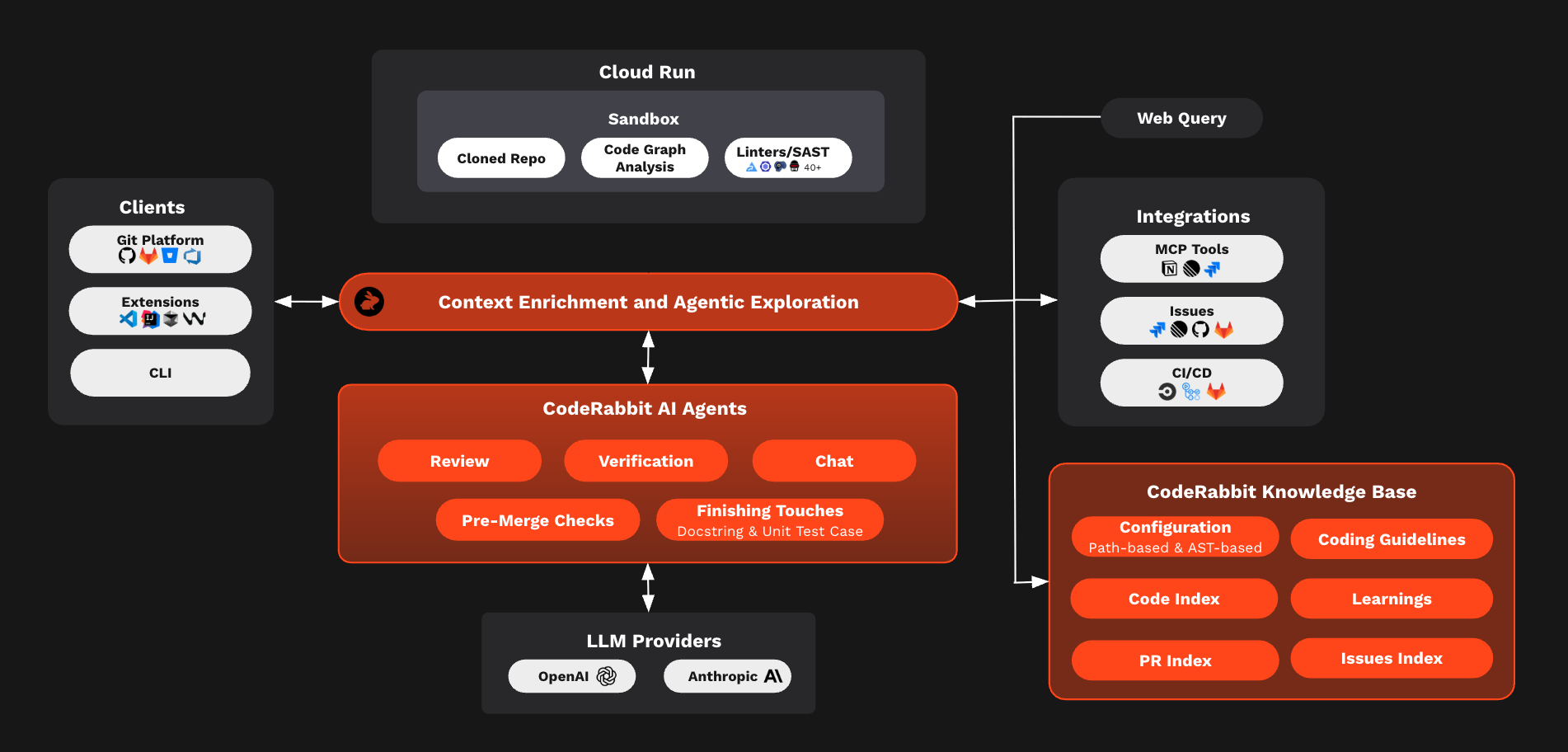 Behind each comment lies:
* **Sandboxed cloud execution** with your full repository cloned for isolated analysis
* **Multi-dimensional code analysis** combining 50+ static analyzers, linters and SAST tools
* **Agentic exploration** that autonomously investigates your codebase for context
* **Specialized AI agents** working in parallel: Review, Verification, Chat, Pre-Merge Checks, and
* **Living memory** that learns from your feedback, PRs, issues, and coding guidelines
* **Enterprise integrations** connecting your entire development workflow
**That's why CodeRabbit doesn't just review code, it understands it.**
Behind each comment lies:
* **Sandboxed cloud execution** with your full repository cloned for isolated analysis
* **Multi-dimensional code analysis** combining 50+ static analyzers, linters and SAST tools
* **Agentic exploration** that autonomously investigates your codebase for context
* **Specialized AI agents** working in parallel: Review, Verification, Chat, Pre-Merge Checks, and
* **Living memory** that learns from your feedback, PRs, issues, and coding guidelines
* **Enterprise integrations** connecting your entire development workflow
**That's why CodeRabbit doesn't just review code, it understands it.**